The Rise Of Fake Private Investigators
The Rise of Invisible and FAKE Investigation Companies: Big Advertising Budgets, Little Accountability.
Dedicated | Diligent | Discreet
Before I start, let me introduce myself. My name is Dan and I am the founder of Anderson & Co Surveillance & Private Investigators Ltd, based here in Birmingham city centre, in the UK. I founded the company back in 2019 after previously working as a surveillance agent for investigation and insurance companies throughout the UK. There's a bit more to how I became a Private Investigator, of which I have discussed in more detail in previous blogs also shared on this website - www.andersonco.co.uk.
Anyway, today's blog is about the increased rise of FAKE private investigation companies here in the UK. This is not something new to me or the industry, but is something that I feel is getting much worse. In years gone by it would be the occasional client here and there, let's say two or three a year, but now, at a guess, I am talking to clients on an almost weekly basis who tell me they have used what they believed to be a reputable Private Investigation company and have sadly been ripped off, lied to and let down. It's now so bad and so frequent, I know every time who they are going to tell me has ripped them off. It's the same small handful of culprits every single time. The same type of culprit who has ruined the image and reputation of the industry for many years.
It's quite a simple scam for them
They have a substantial nationwide presence online, yet offer remarkably little transparency about who they really are. They invest thousands of pounds into Google Ads, search engine optimisation (SEO) and professionally designed websites, ensuring their businesses appear prominently when members of the public search for private investigators across the UK.
Their websites may contain dozens, sometimes hundreds, of location-specific pages advertising services in Birmingham, Manchester, London and other major cities. To an unsuspecting client, this can create the impression of a substantial, established organisation with experienced investigators operating throughout the country. They have landing pages and satellite addresses in just about every town, city and village nationwide. However, look a little closer and a very different picture may emerge....
There may be no identifiable limited company registration, no independently verifiable professional memberships, no recognised industry awards, no established Google Business Profile, no names mentioned online, no LinkedIn and no meaningful history of independent customer feedback - the list goes on.
Now, it is important to recognise that operating as a sole trader is perfectly legitimate and that professional memberships, awards and Google listings are not mandatory requirements for private investigators, although seen as good, professional practice to have these affiliations and registrations.
Nevertheless, when several of these elements are absent, particularly alongside exaggerated claims about the size or experience of a business, prospective clients should ask further questions. If you have a team of 30 agents and have been around 40 years with 5350 five star reviews, why are you not a Limited company? Why no physical office? Why no social media? Why no industry affiliations? And where are these five star reviews?
Any business can spend thousands of pounds a month making itself visible online without necessarily investing the same amount in professional expertise, operational standards or accountability. They work on law of averages and know by using such tactics the enquiries are non-stop - they only need one or two clients a day to fall for their false and unrealistic promises, and they are "quid's in".
But, what Happens When Something Goes Wrong?
Perhaps the most troubling aspect of dealing with an unaccountable investigation provider is what happens when a client is dissatisfied.
Imagine paying a substantial sum for an investigation, only to receive a poor-quality report, if at all, questionable evidence or information that proves to be completely inaccurate and fictitious - that's right, there are FAKE investigation companies who are providing completely fictitious reports, using AI software and charging extortionate amounts for doing so....
So, who do you contact?
Where is the business genuinely located?
Who is legally responsible for the services provided?
Leading | Established | Award Winning
If the website provides little more than a telephone number and an enquiry form, pursuing a complaint or obtaining a refund can become unnecessarily difficult. Without an established public review profile, dissatisfied clients may also find it harder to share their experiences and warn others. A missing Google Business Profile does not prevent someone from making a complaint, pursuing a civil claim or reporting suspected wrongdoing to the appropriate authorities.
However, limited business transparency can make identifying the responsible person or organisation more challenging. This is precisely why accountability matters. A reputable investigation company should be willing to identify it's legal trading entity, explain its complaints procedure and provide clear contractual terms.
Fabricated Background Checks: When Clients Pay for Information That Simply Isn't True
Perhaps one of the most disturbing concerns within the private investigation industry is the apparent fabrication of information presented within semi-presentable background check reports. A legitimate background investigation should involve carefully examining available information, identifying relevant connections and establishing facts through appropriate, lawful and reliable sources.
Depending on the nature and lawful scope of the enquiry, this might involve confirming residential addresses, examining business associations, identifying relevant publicly available records and social media or investigating other legitimate background information.
However, what happens when an investigator simply invents the information?
What happens when a client pays hundreds of pounds for a detailed background check, only to discover that the addresses, personal details and supposed findings cannot be substantiated?
Unfortunately, at Anderson & Co Surveillance and Private Investigators Ltd, we encounter precisely these concerns and on a frequent basis.
Our Experience of Clients Receiving False Background Check Information
We have been approached by clients who have sadly and frustratingly fallen victim to this type of scam, believing the glossy, well-made website, sat pretty on the top of page one of Google - either via a paid ad or organically through a large SEO budget.
These clients had already paid for what they believed would be genuine, professionally researched information from a reputable Private Investigation company who sounded totally convincing and believable. They were subsequently supplied with reports that appeared credible and reasonably well presented, although in most cases they are very limited. We have noticed they give enough information to create the illusion of a subject being identified, with a semi-believable backstory to go with, but not enough information to reliably confirm all of the information. the information will often be vague and missing crucial identifiers - house numbers, missing digits from phone numbers, companies that aren't registered and/or don't exist - the list goes on.
However, when those clients begin questioning the accuracy of the information, they report experiencing considerable difficulties obtaining satisfactory explanations. All of a sudden the investigator who carried out the investigation isn't available. The tone quickly changes. They are told to call back the next day and then the same happens again. In many cases they tell me that communication ceased entirely, while others mention being blocked right away. We have also noticed that when making payment these companies use a mixture of completely random company and personal names that have no connection to any Private Investigation company - this further makes tracking them down tricky and hard to locate. In most cases where a persons name has been used it is generic and common and most likely a friend of a friend used to receive payment on their behalf, in return the person receiving the payment will most likely receive some form of "commission".
Anyway, having lost confidence in the information they had purchased, they find themselves approaching us to undertake independent verifications. In the cases referred to us that we have examined over recent years the disputed information has repeatedly failed our verification checks.
We have encountered addresses and other details that could not be substantiated through our subsequent enquiries, despite having been presented to the original clients as reliable findings. All created to give the impression it's is a legitimate check on the person of interest.
These experiences raise serious concerns about the standards applied by some "investigation providers". An incorrect address does not, by itself, prove deliberate fraud. However, information presented as a verified current address should be supported by appropriate, up-to-date checks. However, repeated substantial inaccuracies, combined with an apparent unwillingness to explain the underlying research or respond to reasonable client concerns, should raise significant questions.
The Difference Between Verified Information and Fabricated Findings
Here at Anderson & Co, our approach is to establish current, accurate and independently verified information rather than rely on unconfirmed assumptions. If information cannot be independently verified - doesn't happen very often, it must not be presented as an established fact.
There is a fundamental difference between identifying a possible address connection and establishing a verified current residential address. Unverified information must never be presented as verified fact simply to make a report appear more comprehensive.
Where a "Private Investigator" knowingly invents addresses, personal details or other findings and sells them as genuine investigative research, at often extortionate amounts, that conduct may amount to fraud.
It is not simply poor investigative practice. It is potentially a deliberate deception of a paying client!
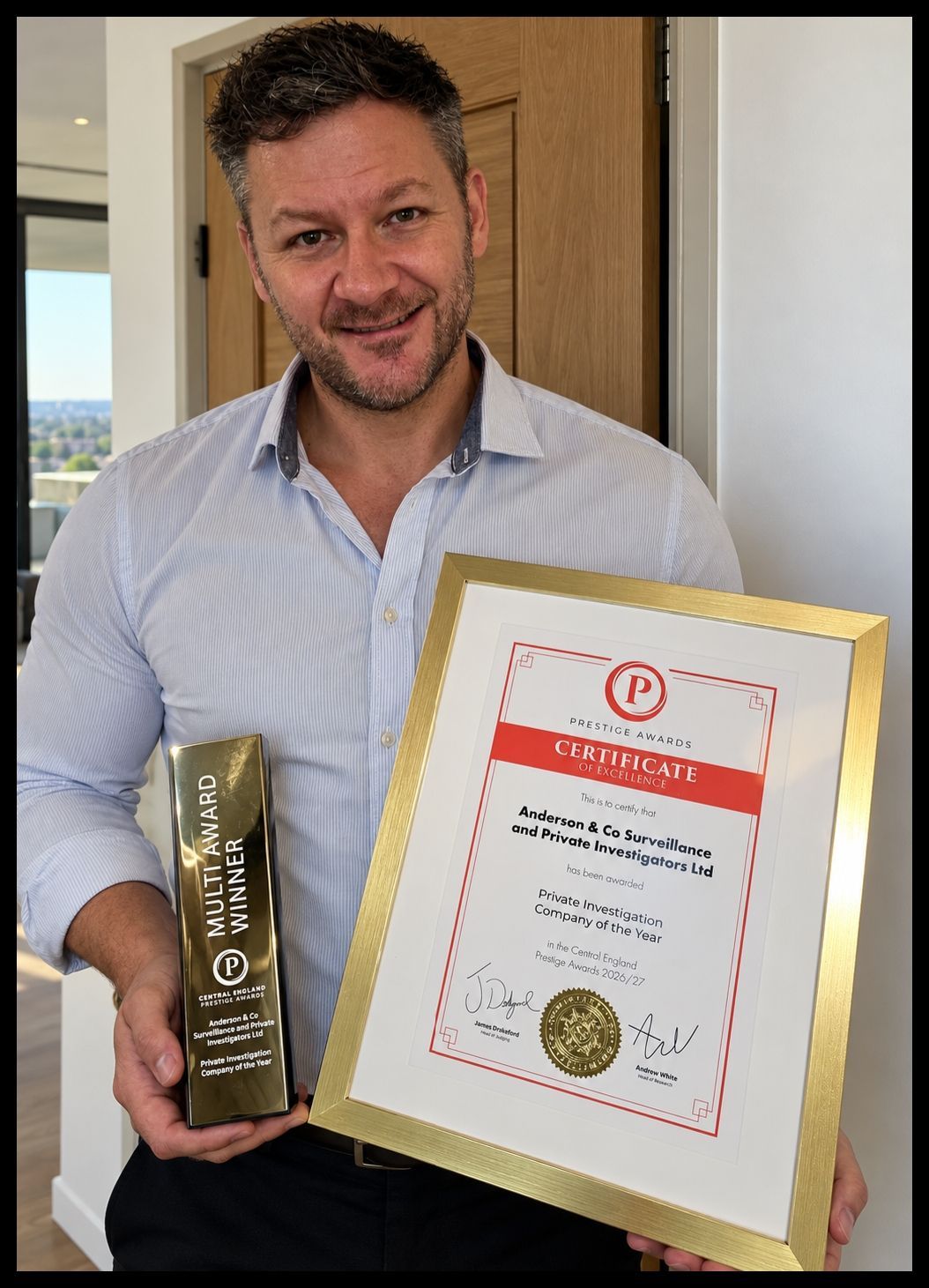
Prestige Award Winners 2025 and 2026
Professionally Presented Reports Can Conceal Completely Unreliable Information.
One reason this problem is particularly concerning is that modern technology makes it extremely easy to produce impressive-looking documents. A background check report might contain a company logo, reference number, professional formatting, tables of personal information and detailed investigative commentary. It may appear to have been compiled following extensive research.
However, presentation and accuracy are two entirely different things.
A polished document does not establish that the information has been obtained from legitimate sources, independently verified or even researched at all. An investigator can produce a twenty-page report containing addresses, alleged family connections, business associations and other personal details. But if those findings are unsupported, the report may be worthless regardless of how professional it looks. Although I have to say, with the reports we have seen that have been produced by the "fraudsters" they are rarely more than five or six pages long and certainly don't include well presented tables and fine detail.
Artificial Intelligence Makes the Problem Even More Concerning.
The rapid development of artificial intelligence introduces another potential avenue for dishonest practices. AI can produce convincing written material within seconds. It can generate structured background reports, detailed narratives, tables, summaries and apparently authoritative explanations.
Used responsibly, these tools can assist professional investigators with administrative tasks. Used dishonestly, however, they could be employed to manufacture entire reports containing fictional or unsupported information. Imagine a client requesting a background check on an individual believed to have disappeared or deliberately concealed their whereabouts. Rather than undertaking genuine research, an unscrupulous operator could use automated tools to produce a plausible report containing supposed residential connections, employment details and other personal information. The client receives an semi-impressive looking document and may initially believe that a substantial investigation has taken place. Yet the information could be entirely false.
We cannot assume that an inaccurate report is always generated using AI without evidence, although recent fake reports show all the indications of AI. Nevertheless, the availability of such technology makes independent verification and professional accountability more important than ever. Artificial intelligence can generate convincing information. It cannot turn invented information into genuine evidence.
The Real Victims Are the Clients
It is important to remember why people instruct private investigators in the first place. Many are dealing with extremely stressful circumstances. Some are attempting to locate individuals who owe them substantial sums of money. Others are trying to find missing relatives, investigate suspected fraud or establish the background of someone entering their personal or professional lives.
These clients are not simply purchasing a document. It is much more than that!
They are paying for information they hope will help them resolve a serious problem. When that information is false, the consequences can be considerable.
A client attempting to recover a debt might waste time and money pursuing an address with no genuine connection to the debtor.
Someone attempting to locate a family member could experience unnecessary emotional distress after being supplied with inaccurate information.
A business relying upon a background check could make important commercial decisions based on unsupported findings.
The client may then have to instruct a second investigation company, effectively paying twice to establish the truth.
Birmingham | Manchester
Here at Anderson & Co, I find this particularly concerning because it can leave clients feeling exploited and understandably reluctant to trust another Private Investigator. Of course, it also takes work away from the legitimate, honest and professional companies like us and many others, too.
Taking Payment Is Not the Same as Conducting an Investigation. A genuine background investigation requires professional judgement, appropriate research methods, lawful access to information and a clear understanding of what can realistically be established.
Not every background enquiry will produce the information a client hopes to obtain. Sometimes it may go against the narrative. An honest investigator must be prepared to explain that.
Sometimes the correct outcome of an investigation is that the available information remains inconclusive. That may be disappointing for the client, but it is infinitely preferable to being supplied with invented findings.
A professional private investigator is paid to establish the truth, not to manufacture an answer.
Genuine Evidence Cannot Be Replaced by Artificial Intelligence
Here at Anderson & Co Surveillance and Private Investigators Ltd, we believe investigative reporting must be grounded in actual investigative work. Professional background check reports should clearly distinguish between verified information, historical records, possible associations and findings that remain inconclusive. Where appropriate and lawful, information should be corroborated using independent sources.
Claims of unrestricted access to private banking information and personal records or devices should be approached with considerable caution. As I always say, "if it sounds too good to be true, it normally is".
Our responsibility is to provide honest findings based on lawful investigative methods and to communicate clearly when information cannot be established. A report containing fewer verified findings is far more valuable than a lengthy document filled with unsupported and false claims.
Visibility Is Not Credibility
The message for anyone considering appointing a private investigator is simple. Do not confuse online visibility with professional credibility. A company appearing repeatedly in Google searches across the country may simply have a substantial advertising budget and an effective SEO strategy. That does not necessarily mean it has experienced investigators, established business premises, a proven track record or the professional standards required to undertake your investigation.
Before paying any money, establish exactly who you are dealing with, verify the business details and ask what safeguards are in place should something go wrong. Ask how findings are verified, how uncertainty is communicated and whether the company has
a clear complaints procedure.
Search for those 4592 five star reviews. Check to see if they are a Limited company dating back to 1982. If not, ask why, then run a mile!
If you have already received a background check report and have concerns about its accuracy, consider obtaining independent verification before relying on the information. When you instruct a private investigator, you are placing your trust in that individual or
organisation. Make sure that trust is justified.
When someone's money, reputation, family or future is at stake, there is absolutely no substitute for genuine and professional investigative work.